Pages

Monday, October 15, 2012

15th October – Papatowai to Curio Bay


I’d read about a place called the Lost Gypsy Gallery, a collection of hand-made automata created from found objects and on display in an old bus, and was really looking forward to having a look round and a chat with the guy who made it. It was just around the corner from the campsite and was immediately enticing with a corrugated iron hand-wound whale and a bunch of crazy wind-vanes. The sad part was that it was closed until 20th October and so we didn't get to go and explore. I especially wanted to go through the arch labeled, ‘Winding Thoughts Theatre of Sorts’ and would have telephoned the guy to beg but we didn’t have a signal on our phone.


We followed the signs for tourist information so we could ask them to call him but it led to a bay with a sign rather than a centre so we just went for a wander down the beach instead. The tide was out past the bay but the waves beyond were ferocious. There was also an almost completely decomposed sheep by the edge of the grassland there too so I’m not feeling too warmly about New Zealand farmers  -  or whoever is responsible for cleaning the beaches for that matter.

It was a really changeable day, with bursts of bright sunshine competing with torrents of rain and so we spent most of the day waiting for the gusty wind to blow the rain away before rushing out to have a quick wander or explore during the reprieve.

We’d noticed Niagara Falls on the map and followed a sign for brief detour to find it. We bobbed over some lovely hummocks and gullies and saw lots more sheep but we couldn’t spot the falls.

The day was somehow flying by and we didn't want to end up in Invercargill during the evening and so we decided to head to a nearby town that had a largish name on the map, Waikawa, for a look around. It turned out that Waikawa was even smaller than Owaka and seemed to just be a few buildings scattered by the side of the road. It did have real tourist info though, staffed by a couple of lovely old ladies in woolly hats who explained the Niagara Falls was named by a surveyor with a sense of humour. There was also a museum but we couldn’t look around it because there was a power cut and it was too dark. We could still see the restored buildings outside though and we couldn't help but chuckle because the town ‘jail’ was just a garden shed with barred windows.

Next stop was Curio Bay, where there was a petrified forest and also possibly our last chance to get a better look at the rare yellow-eyed penguin. We underestimated the length of the day and arrived early and so stood waiting on the viewing platform in the cold, rain and wind for well over an hour, shivering and watching the huge waves crashing against the cliffs. We could see the petrified forest just under the water and a rainbow that seemed to be continuously drawing itself, rubbing itself out and starting again.

It was just getting to the time when we were really expecting the penguins to appear when a group of 6 French people turned up and started to walk down onto the beach, something that we’d been warned against at every other site. I asked them very nicely not to and explained that we had been waiting there for a long time. They carried on regardless and one of them turned to say that they’d been there yesterday and the penguins had still come onto the beach.

I was furious. But other than chase them down the beach shouting about how the penguins were nesting and might come on anyway but it didn't mean that they weren't scared and just trying to find a way to feed their babies. I was even more livid when they then started poking away around the nesting sites right at the other end of the beach. By the time they came back I was so incensed that I would have just exploded if I opened my mouth, especially when the one friend who had not gone had clearly told them about my raving about it and they all gave me smug smiles.


Of course, with them already on the beach, I was totally unable to do anything about the brightly dressed and careless-footed troop of people who then turned up and started to stream down there. I could not stand to watch them tramping all over the area that should be protected and preserved and so went back to the car.
We were just pulling away when a German guy who’d waited on the platform with us came running and told us that the first penguin had eventually braved coming out of the water. We ran back for a look and saw one climb to its nest undisturbed but then everyone flocked to that spot with their cameras. The next poor penguin got halfway home and then had no idea what to do when it couldn’t get any further because here were people squatting in its way,  pointing their long-zoom lenses at the poor thing. I stalked back to the car in a big, sulky disgust.

We stayed nearby at a cool little campsite that was right on the cliffs by the sea and had bays marked by long grasses to buffer some of the fierce winds. It had a little round kitchen and a little round shower block but both were busy so we just sat in the car while I sewed the other curtain and Matt used his pen-knife to individually whittle down a bunch of curtain-sliders to fit the back curtain rail. We felt rather traditional.

Sunday, October 14, 2012

14th October- Allanton to Papatowai


We woke up to incredible views of rolling green hills, dotted with sheep and cows, coloured with trees and bright yellow gorse, and sandwiched between pure white icey mountains and the flat blue sea.


We followed the country roads further, trying to get as high as we could. We didn't get as high as we would have liked but we got some fabulous views and used a fair bit of fuel trying.

We got ourselves onto the Southern Scenic Route road and weren't driving very long before we took a short detour to see Cannibal Bay. We didn't find out why it was called that but we did see some remnants of the huge masses of sea kelp that lurk by the shore, stranded on the beach. It's really fascinating-looking stuff and I had to resist a real urge to poke, squidge and play with its thick, juicy looking tubers.

We had barely started on our walk and were just admiring the ferocity of the waves when we noticed a huge sea-lion lolling by the cliff. It's dangerous to pass between them and the sea and inadvisable to go within 10m of one so since passing this chubster would have meant flouting both of these 'rules', we chickened out and went back to the van to make a nice hot coffee.

Next stop was the Catlin's Main town, Owaka, which boasts a hefty population of 395. We stopped at the tourist info to see if they had any information about walks. they weren't particularly helpful on that score but they did have a great museum, especially considering the size of the town. We enjoyed finding out about the local shipwrecks, industries and locality and I really enjoyed reading the projects about local people, done by school children. We nearly got a longer spell in there than we'd planned though because the guy had got halfway through bolting the doors when we got to the exit. He was just telling the other lady working there that we'd left as we turned the corner. This would have been particularly funny because he'd made a dry and possibly sarcastic joke about not getting locked in when I'd enquired about whether we had enough time to look around.

Though thinking about it, he may have done it on purpose. When I spoke to him the first time there was a large, black book on his desk that had 'Death Book' written on it, seemingly in Tippex. When we went back to pay for the museum, he had it open and was reading through the obituaries that had been cut out of the paper and glued in there.

We continued further, following the road around a sea inlet and aiming towards Jack's blowhole. We had to stop on the way to take a picture of a giant rainbow that arched completely over the road. It was the widest and thickest I think I've ever seen but the right side was already fading by the time I got out of the car.

We stopped on the edge of a windswept beach flanked by black and white cliffs and started the steep climb to Jack's Blowhole. The views were astounding as usual but as always, it was hard to capture the multitude of greens and the contrast of the high, green, sheep-dappled clifftops, with the blue sea far below and the slate-gray rocky outcrops. And there were loads of extremely cute, long-tailed, fluffy lambs frolicking about.


Now there are lots of things that I'd kind of forgotten about walking in a cold climate that came rushing back to me as we struggled against the wind, including that:

You never have enough tissues to cope with your continuously streaming and sore nose.

It's totally possible to be sweaty on some parts of your body whilst feeling the effects of near frostbite in others.

Cold-air somehow burns your lungs.

Driving rain can feel like someone is chucking needles in your face.

Despite all the discomfort, it's somehow invigorating.

We weren't quite sure what to expect from Jack's blowhole but it was a lot bigger and a lot less blowey than we'd imagined. Named after a frequently cussing Moari chief, it was 155m deep, 144m long, 68m wide and sat in the middle of a sheep-field just 200m from the sea. We stood on a ledge at the top and watched as the waves rushed under the natural arch and licked up the sheer sides of the hole in the land. It was easy to imagine that on a stormy day, the impact might shoot the spray upwards but today the sea there was fairly calm.

On the walk back, I was pretty distressed to see a dead sheep lying peacefully in the gully next to the path. It looked very recent and we hadn't noticed it on the way there so we stopped for a while and looked carefully to see if it was still breathing. Matt meanly refused to try and stand it back on its feet and insisted that I was satisfied with looking out for a farmer to tell. A few hundred metres further down we noticed a slightly lumpy sheep skin further up the slope that could only really have been a decomposing sheep and so had to conclude that the farmer was not likely to be anywhere close. Matt still refused to go back and make any attempts at resuscitation.

After a cold coffee (it turned out our 'new' flask is missing the seal), we took the gravelly road to Purakaunui Falls and had a quick wander to those before making our way to the Papatowai DoC camp site that the tourist info guy had told us about. We think it must have been recently created because it wasn't on our maps but we thought we'd give it a go because the old guy had told us that it had an 'ablutions area', a term I've only ever heard in French or in reference to mosques. I'm sure his odd choice of words for a wash-block, his lack of a full set of fingers (I don't like to mention them but I can't get the image of him 'pointing' out of my head) and his interest in death, all have a very righteous and worthy back-story that would put me to shame but they do add up to an irresistible character formation.

The ablutions block was gratefully received too. It was a rainy, cold evening and we were grateful for the sheltered area to cook and wash. In fact, the campsite was very nice and we had it all to ourselves again so thank you NZ Department of Conservation.

Saturday, October 13, 2012

13th October - Dunedin to Allanton


After the fun of yesterday, it was quite a grim start to the day. I was tired because it had rained a lot during the night and we'd been parked under a tree. There are few things more annoying than the loud and irregular tap-tap-tapping of water falling from leaves onto the metal roof of a van - like sleeping in a room full of amplified dripping taps. It's particularly annoying when sleep is the only thing keeping your mind off needing the loo.

Added to that, it was a cold, grey, windy day of the sort I haven't seen since we left the UK. I've always struggled with the cold and hate feeling bundled up, hunched and tense against it but it's interesting to see how much more it bothers Matt now he's lost his insulating layer.

We made our way down to Dunedin city centre for a day of indoor sight-seeing, starting with the art gallery. There was the usual mix of talent, interest and obscurity but we spent most time at an exhibition called, 'Breaking Down the Fourth Wall' - more for its documentary content than its artistic merit - that focused on alleged 'first contact' with the Tanahashi tribe.

After lunch we went to the Otago Museum where they had a great display of items from Edmund Hillary's Everest expedition, including the second-hand camera he used to take the iconic summit of placing the flag at the summit.

General stars of the show for me were the animals there though. I was gob-smacked at the size of lots of things including: a stuffed sunfish in the foyer, which was only half the maximum size; the skeletons of native moa birds, now unfortunately extinct due to being munched up; and the stuffed albatross, particularly the baby one since it was bigger than most small dogs. We also got to see the dinosaur fossil from Shag Point which was pretty impressive.

We were still happily exploring the museum when the call that it was closing came so we went to Moana swimming baths. There were huge and really well layed-out with lots of lane swimming organised by speed. I stayed in one of the slow lanes of the shallow end doing laps until I got tired, then I skirted the diving pool (with just an envious glance) and joined Matt in the fun pool to play in the 'lazy river', waves and toasty warm spa pool.

Last stop in the city was Baldwin Street - the steepest hill in the world. We drove up it, climbing to a height of 47m over 161m length. With an average gradient of 1 in 3.41 and the steepest gradient of 1 in 2.86, it would be good to see the 'Baldwin Street Gutbuster' foot race that happens there every year. We wouldn't fancy living in one of the houses at the top during snowy weather though. There were even several little shops selling certificates to testify to the achievement of driving up it.

After seeing the albatross in the museum, I was really keen to see some real ones that weren't full of straw with plastic eyes, so we took the scenic drive right along the edge of the sea to Otago peninsula where there's a colony. We didn't realise it was a privately owned colony until we were over halfway there so we trucked on anyway in the hope that that we might get to see some flying around.

It was dark when we got there so we just took a little wander along the path around the tip of the peninsula. We didn't see any albatross I don't think (although I did see something pretty huge flying up ahead before the darkness fell too thick) but we did spook a mass of seagulls that Matt kept insisting might be albatross. I got a closer look at them as they dive-bombed near my head - especially the one he was annoying by shining a torch at at the time - so I'm certain they were just gulls. It was freezing cold, so windy it was hard to walk straight and the gulls were still making a horrid noise and acting odd so we didn't stay for very long.

We took a  steady drive back because the lack of barriers between us and the sea made driving in icy rain just that bit more dangerous.

Instead of staying at Dunedin we decided to make a little bit of progress so got on to the highway out of the city. We soon hit roadblock where the police were stopping to breathe-test them. The policeman was pretty rude to Matt because he thought that had to pull over rather than stop next to the guy and block off all the traffic. Matt was very polite back though and we were soon on our way - Matt was just a bit disappointed because he felt he should get a minus reading for not having a drink for so long.

It was getting late though so we didn't drive very far before we felt it was time to rest. We took a street away from the main road and up the hills and stayed on the first flat patch we could find. It was muddy and the wind was blowing a gale so we crawled straight into bed and wrapped ourselves in blankets.

Friday, October 12, 2012

12th October - Glencoe to Oamaru

We were woken up by an insolent cockerel that was very deliberately targeting us by crowing outside our windows and pecking at the car. He seemed to consider himself part of our little crew and stuck close-by, oozing attitude and taking a close look at everything we did, for the whole time it took to re-organise the car and make breakfast.

After trying out our new curtains last night, we realised that they would be better if we could put them up lengthways. I'd bought some curtin tape yesterday but didn't fancy hand-sewing them and so we headed back to the reclamation centre where we'd seen a hand-held machine. It turned out that the shop was closed on Fridays but I thought I'd try my luck. I explained to the lady at the gate that I knew what I wanted and where it was and, surprisingly, she radioed through to someone else, who then came out to get me and escort me through the shop to get what I wanted. Even better, it still had working batteries in it!


Since it was Friday, I was determined to make the most of some of the things that I wasn't able to do yesterday and first stop in the main town, after a quick op-shop stuff swop of course, was Annie's Victorian Tea Rooms. They were everything I'd hoped for and more: jam-packed with period paraphenalia and very elegant indeed. We sat by the flaming fireplace, watched over by a very stern-looking Queen Victoria and a stuffed deer head, and indulged ourselves with giant silver pots of tea and petite dishes of 'Colonial Goose' (mutton) sandwiches with the crusts cut off and Savoury Gem. The waitresses wore period dress and served with a curtsy and a deferential, 'Ma'am'. The sight of the cake trolley that they kept wheeling to the different tables made us both wide-eyed with wonder and we made no attempt to resist. Deciding between them was tough but we somehow managed. We weren't so successful at finishing them though and had to ask to take them away because there was no way we were leaving without them.

We had a chat with a grumpy-looking but very nice Scotsman who had moved to New Zealand 22 years ago and now worked at the local polytechnic. He said that he missed the UK but had only been home once and that was in 2010. I was a bit too scared to tell him that he clearly wasn't trying very hard.

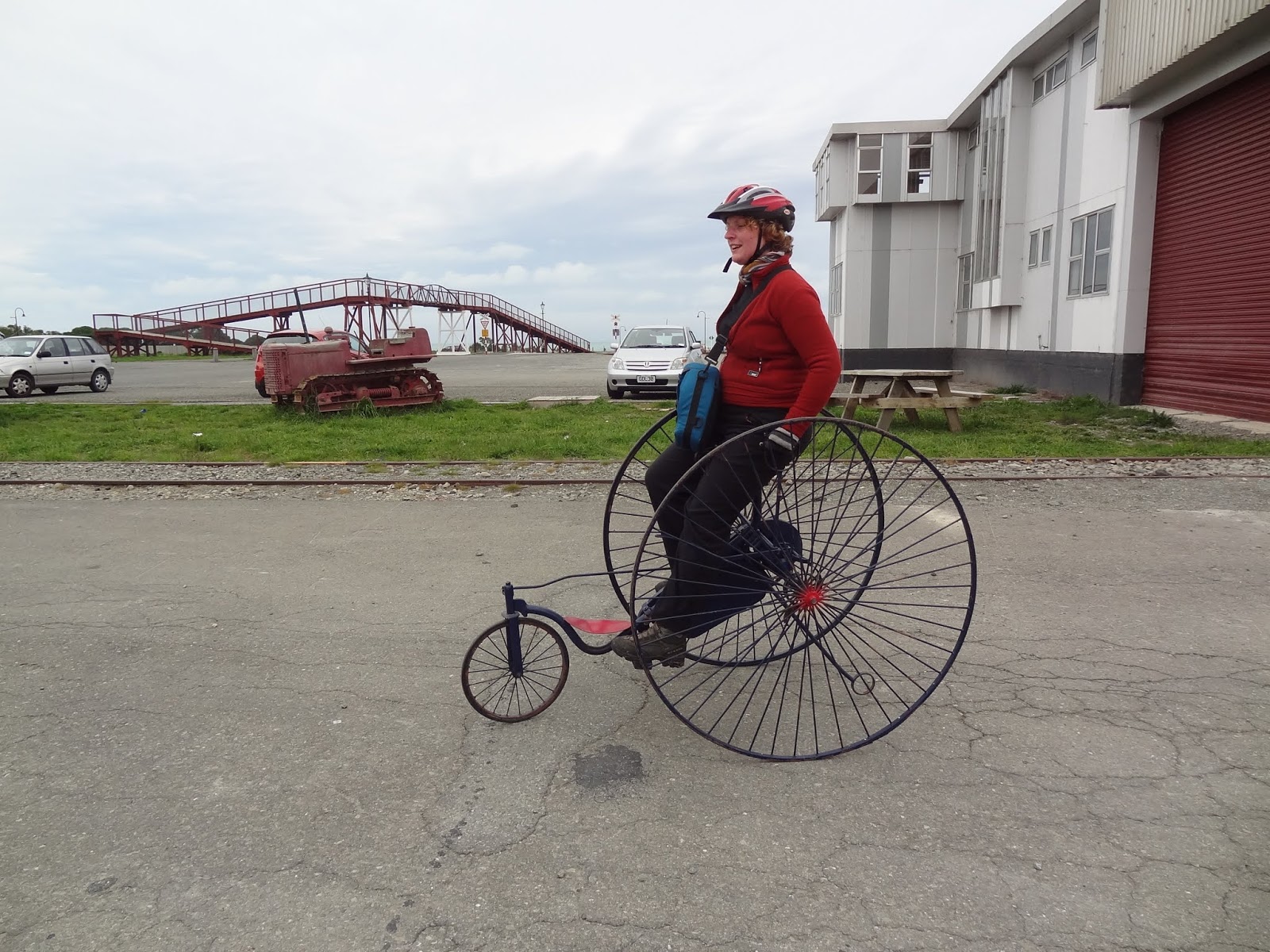
Next stop was Oamaru Cycle Works where we met the owner, David, and rode replica 1880s Penny Farthings, a replica trike from the same period and a 1930s 3-wheeled delivery bike. We started with  small Penny Farthings, and I was proud to be complimented on my technique by a nearby enthusiast. Graduating on to the full-size version was not so successful and though Matt, with his affinity for all things mechanical, seemed to manage the transition smoothly, I went solo for just a few seconds before I started wobbly wildly. David was very chivalrous and made a grab for me before the bike but I still hit the floor. He was very concerned but I was completely unscathed, much to my disappointment since I would have very much liked a small scar from falling off a Penny Farthing.


Small one first 
Anji's fall
Graduated to the full size
Anji & David


We explored the shop and admired the huge touring Penny Farthing, all trussed up with camping gear. David told us that he had spent 3 months travelling around on it which must have really raised a few eyebrows because. not only did he have a very distinct moustache, the bike was nearly as tall as me. He told us that whenever he encountered a hill, he had to get off and walk with it.

I pumped him further for information and found out that he works with Annie of tea-shop fame and that he runs a consultancy helping towns with historical interests, capitalise on them for tourism purposes. I also found out that he had a few songs written about him (apparently not available on YouTube) and that the huge Penny Farthing swing frame we had seen on the park was actually a sculpture of him.

David armed us with information on the town, and we waved goodbye to him, his 'tache and his young assistant, Bailey.  He did insist that we visit the whisky shop and the art gallery so we took his advice.
The whisky shop was worth a look but the art gallery above it was wonderful. The large loft was a piece of art in itself and we were even more enamored by the space than we were the artwork. The Scottish guy was there chatting to the owner and we overheard that he was also a local artist. We chatted to them briefly and the lady recommended going to Shag Point (insert a few jokes from the Scottish guy here) on our way to Dunedin.

We were about to finally say goodbye to this charismatic town when Matt caught sight of the hand-made hat shop, 'Flocked and Fleeced', and just had to go in. I struck up a conversation with the lady inside and she seemed quite reticent at first but soon got into the swing of it - over half an hour later we were still chatting away. She showed us how she made some of the hats, told us more about her love of felting and shared some of her personal family history. I found her really inspiring and encouraging and I left with a very fuzzy feeling and an enthusiastic recommendation for the artisan cheese factory. I must remember to look her up at Hoda Gallery on Facebook.

We had to go past the bike shop to go to the car and David stopped us to insist I had another go on the Penny Farthing and better my 'most elegant first dismount'. I wish I could say that I managed it with elegance and flair this time but instead I simply had to be satisfied with staying upright - and the (hopefully) tongue-in-cheek offer of marriage.

A quick visit to the cheese shop, a glance around their factory and a cheeky purchase of their signature 'Windsor Blue' and we finally bid a sad goodbye to this memorable town of steam Punk, penguins, op-shops, accordion-players, afternoon tea, Victorian bikes, milliners and whisky.

On the road out of Oamaru, we came across Moeraki Boulders, where large spherical calcite rocks over 4 million years old, rest along the beach. They are 'concretions'and are understood to form much in the same as pearls, but around larger bodies such as a bone fragment or bone. I really liked the ones that had split open and lay with their layers exposed.


Further down the road we hit Matakaea Scenic Reserve, otherwise known as 'Shag Point', where it is possible to see sea-lions, seals and penguins. We were walking towards the viewing point overlooking the rocks when I caught my breath; what we thought was a boulder in the grass turned round and looked at us.  There wasn't a single seal near the water but we had just stumbled straight on one lying right beside us on the grass. I had visions of us being chased round the edge of a cliff by an angry hunk of blubber running on two flippers and so steered well clear.

The other notable thing about Shag Point is that an almost complete skeleton of a 7 metre-long Elasmosaur, the largest marine reptiles of all time and extinct for about 65 million years, was found here in the 1980s, at the centre of a Katiki boulder. Katiki boulders are very similar to the Moeraki boulders further north but tend to erode from the inside out.

50km later and we arrived at the city of endless hills: Dunedin. We checked out a few campsites but none of them were very appealing and so we headed for the country lanes.

We parked up next to some pretty sheep but I was still hyped up after our great day and wasn't ready to sleep yet so we had a stab at using the hand-held sewing machine to turn the lengthways curtains into sideways curtains to cover the cab of the car. We guessed that anyone driving past would be too disturbed by the sight of us sat in a pitch-dark lane making curtains to bother us.

After a bit of a difficult start where I was convinced the machine was broken, we made quick progress until, upon completion, I realised that we’d sewn the curtain tape on the wrong way and had actually made upside-down curtains. After a quick debate about whose fault it was, I unpicked the tape and we measured out a new length and started again. Experience made us faster still. Then we ran out of cotton. We had managed to stitch one side of the tape though so even though the curtain hung a bit floppily, it hung nonetheless and we were quite proud of our handiwork.

Wednesday, October 10, 2012

10th October - Christchurch to Oamaru


I had quite a cosy night in my PJs but poor Matty didn't fare so well 'cos he'd insisted on using the cheapy sleeping bag we bought as a blanket for us both and sleepy Anj had nicked it.

Matt had the morning doing the obligatory fiddling that he has to do with any new car and fixed the rear speaker.

I felt my first after-shock. It felt like a large lorry going past and rattling everything but I guess the guys are more sensitive to it after more 12300 aftershocks. They looked it up shortly and it measured 4.5 on the Richter scale and had originated in the sea quite near Gary's house. Most of them are fairly mild now and the likelihood of another big one is low but they are still constant. There had been about 12 in the previous 7 days and, although I'd heard they had happened, it was the first I'd noticed.

Matt came in from the shower immediately after and made us all laugh. Richard asked him, "Did you feel that?" but Matt misunderstood and replied, "Yeah, it was lovely." He hadn't noticed it at all as he'd walked through the workshop.

We waved goodbye, promising photographs, and headed on our way. We had a quick stop to buy some rather fetching pink boxes to store our stuff in under the bed then set off down the East Coast.
The views down the East Coast were breathtaking in places. We could see the same mountains we had on the plane and they no looked unbelievable - less like a documentary and more like a fantasy.
It was hard to keep cracking on to Oamaru and not stop at some of the pretty looking places on the way but we made it.

The town itself was a fabulous-looking place. A real Victorian industrial section retained lots of its originality and had been sensitively restored to avoid making any of it look overly-polished. The whole historical area just seemed to have gravity and poise.

We stopped at the port by the most awesome kid's park I've ever seen. It had a giant penny farthing as a frame for the swings and some industrial machinery (not sure what you call a crane mounted on a train) as a climbing frame. There's no way a local council at home would have approved it for health and safety reasons.
I had a quick jog around the port and swallowed lots of flies while Matt wandered around and read the info signs. The was a curved-approach wooden wharf on one side of the port and great big warehouses from the time of the area's main industries of wool and grain on the other. Lots of the buildings still had their original signage and were now used for an art gallery, hat shop, whiskey purveyors, an off-beat bar and a host of other establishments that were unfortunately closed. There were also lots of relics from the locomotive era dotted around on the path. They were really rusty and looked like they might once have been buried beneath the sea but they added to the atmosphere.

One of the reasons we'd chosen Oamaru was because of the penguins there. At the edge of the port there was a colony for Blue Penguins where you could see them come home after a days fishing. We were told by an old guy - who we'd seen rowing a surfboard on the water - not to bother paying to go in the colony but to wait by the wharf to see them cross the road to bed.

We'd read at the tourist info that we should go at 7.45 at this time of year but we arrived about half an hour early. By 8.30 we were freezing but all the people who'd paid weren't out yet and so we thought maybe they hadn't come home.

A car pulled in and a family got out, looked over the beach and then headed back to the car when they didn't see anything. The man told us that he'd just seen penguins and sea-lions on Bushy Beach and that we might be better heading there. I wasn't ready to give up so got chatting to a Turkish guy to pass the time. He told us that last time he'd paid to go to the colony, they'd seen the penguins really far away and then walked outside and seen lots of them on the road and so had decided to stay out there while his wife took the kids to the proper viewing area.

It must have been about 9pm and very dark when we finally caught sight of a tiny little penguin cautiously making it's way up the boat ramp from the sea. It looked very unsure of itself and spent lots of time huddling in the shadows. It turned out to be rather brave though and it wasn't long until it put its tiny little head down and ran across the road as fast as it could.

Other penguins eventually turned up and huddled in groups under a bush waiting for the bravest the take the first steps out of the shadows. Unfortunately, this seemed to coincide with when many cars started to leave the colony so it was a good job that a volunteer 'Penguin Advocate' was there to stop them being ploughed over.

We found a lovely camping spot up on the cliff overlooking the sea and looked forward to a day of doing some of the things we'd read about.

Thursday, September 6, 2012

6th September - Sydney


Following yesterday's 'Tour Day', we decided to have an 'Art Day' and, after watching the lady at the hostel reception desk labour at the computer and being permitted another night in the 6-bed dorm (yay!), we made our way to the docks to catch the free ferry to Cockatoo Island.

Cockatoo Island was a secondary penal colony and one of Australia's biggest ship-yards and, as part of the Biennale celebrations of the city, an exhibition was being held in the vast expanse of the corrugated iron ship-building sheds. Most of the cavernous rooms contained installations of contemporary visual arts, from the impressive to the pretentiously obscure. Our favourites were a detailed filigree cage cut from a shipping container and a massive array of giant polystyrene chains which draped over a collection of gigantic industrial machines.

The dog-leg tunnel and the old prison building about the island also housed installations, some of which were perfectly suited to their surroundings while others were overpowered by the beauty and decay of the buildings themselves. Unfortunately, it was one of those exhibitions where the 'explanatory plaques' didn't bother to illuminate the work but instead gave verbose, existential descriptions  that served only to confuse people, rather than give them insight into the motivations and messages of the work.

One of the most interesting areas was the Museum of Copulatory organs, which contained magnified images and models of the penises of tiny little insects; some of which could only be described as beautiful.
Less enthralling for us personally were the 'sculptures' of beeswax which mostly just looked like melted beeswax and a collection of stones and little glass bottles. Asking the staff on hand about them did elicit interesting background stories but they started Matt on his usual questioning spiral (to me of course, not them) of what art actually is.

We took the ferry back and went back to Subway because we were starving and we knew where it was, it was predictable, and Matt wanted to claim his free cookie for completing an online survey for them yesterday!

The evening was spent in the Museum of Contemporary Art where there was more of the Biennale, some indigineous cultures installations and a cool glass lift with views over the harbour. I particularly liked the work of a Thai guy called Kamin Lertchaiprasert who had used Thai Baht to make papier mache sculptures representing his insight into himself and his family and friends for every single day of the year. Not only were they interesting, moving and comical themselves, the sight of them stretching off down the wall museum made me feel a lot better about struggling with the mammoth task that I have set myself in writing this blog. And a lot more determined to complete it.

We were about to do a last scoot round of the things we hadn't seen (I do hate to leave things incomplete) when there was an announcement about a free tour of the Biennale work. We'd looked at those floors already but I couldn't resist so we went round them all again with the tour group. Although I was very tired and my feet were hurting I was really glad we did and I enjoyed the additional insight we got into the installations. 

The end of the night was spent watching crappy TV  in the common room and struggling to hear the 'dialogue' of 'Operation Repo' while tuning out the banging music and partying of drunken groups of hostelers at the other side of the kitchen. The contrast to our day led to an inevitable feeling of being old.

Wednesday, September 5, 2012

5th Sept - Sydney


We made ourselves popular in our dorm room by setting our alarm for 7 so we had time to sort out the SIM card before going on a tour. At least we only disturbed 4 other people instead of the 30 others we were meant to share a dorm room with.

We booked in for another night at reception and were thankfully allowed to stay in our current room instead of moving to 'The Church'.

We met the tour guide, Matt, at the Town Hall and were shepherded around with about 20 other people. We were introduced to St.Mary's Cathedral, the largest post-WW2 cathedral in the world, which was only finished in 2000, when the Olympcs came to Sydney.

Next, we saw a Queen Victoria statue that originally lived in Ireland. They didn't want it and so it was kept in storage for 40 years before being shipped to Australia and finding a new home outside the Queen Victoria Building (QVB) shopping centre.

Nearby was Queen Vic's dog, who guarded a wishing well raising money for charity and who had been given a voice by a popular Oz radio presenter to encourage people to donate.

We walked through QVB, looking at a few items of interest and were told about a letter that Queen Elizabeth II had left last time she visited. It was addressed to all the people of Sydney with a caveat that it could not be opened for 99 years. Matt and I entertained ourselves with the idea of what it might actually say.

Next major stop was Hyde Park, where there was a fountain that had been designed to signify the unity between Australia and France but seemed to be adorned using figures from Greek mythology, with Apollo looking rather grand on top!

We looked at Hyde Park Barracks heard a bit about Governor Macquarie and the first proper hospital that he wanted to have built because he had a vision of New South Wales becoming more than a penal colony.
The British Government refused to provide any money to build the hospital but Macquarie was determined and so garnered funds by promising a monopoly on rum production to a few major businessmen.

Some of the hospital still provides medical care but, since it was so extensive, the South Wing was commandeered by government to become the first mint in commonwealth outside of the British Isles and the north wing became parliament house.

After telling us more about Sydney's best practical joke and the locations which had been used in a number of films, we went to Australia Square to have a quick rest break and meet Bob: a very lifelike sculpture of a guy reading a newspaper, created by one the Johnsons (from Johnson & Johnson pharmaceuticals) who had been cut out of the will to the family fortune and so had to make a name for himself.

The rest of the tour explored 'the rocks' area at Sydney harbour, including some pubs and stories of 'pressganging', the bridge and how it was hated, and the Opera House - which the architect never saw completed after he was screwed over by the government.

We sat and made some phonecalls to Colleen and Anna before running into a lady we'd met on the tour called Andrea. She was very nice and was in Sydney with her husband and was just keeping herself entertained while he was at a conference. She had been a teacher before she retired and she loved to talk, so we listened to stories of her career and her own children before getting so hungry we needed to leave.

After lunch (oh Asia we do miss your food but I can't say it felt too awful to scoff a subway!), we walked the 1.3km over Harbour Bridge to the little town on the North Shore. We wanted to take a look at Luna park but there wasn't enough time so we just did a circuit and headed back over the bridge in time for the evening tour.

The tour guide initially came across as a quite a quiet, measured guy but as soon as he started guiding, he kicked into life and became this over-animated, squeaky, arm-flapper who constantly used upspeak, making everything sound like an indignant question. This was particularly emphasised when he was making a joke and Matt was soon squeezing my hand in anger.

He did show us some really great parts of 'the rocks' but we couldn't focus as much on content as we did tone. We saw some 'tiny, historic, terraced houses' the same age, size and build as ours, and wandered some of the smaller lanes hearing about the gangs and goings-on that used to occur there. We heard about the conditions that people lived in, the ways the convicts prospered (especially Mr Cobb, the butcher) and the dangers to sailors entering the area.

We walked past a number of pubs laying claim to being the 'oldest public house' in the area, the locations of public hangings and area of expensive redevelopment, including some flats on the wharf that would set you back over $14 million dollars for one apartment.

The last major stop was outside the observatory, where we got a lovely panoramic view of the city at night. We'd both become pretty tired of trying to tune in by then so all we remember is a hazy story about how instead of having the cannons pointing out to the sea, they had them pointing inwards to protect themselves against the convicts.

We supermarket shopped on the way back to the hostel and cooked and ate amongst the bustle of drunken 20-somethings who were earning more money than I was by waiting tables and typing up documents. Jealous? Me?